
The International English Language Testing System speaking test includes a section called the cue card. Many students feel nervous about this part because they must speak alone for almost two minutes. However, if you understand the format and practice regularly, you can handle it easily.
This guide explains IELTS cue cards in simple language so students can prepare confidently and improve their speaking score.
What Is a Cue Card in IELTS?
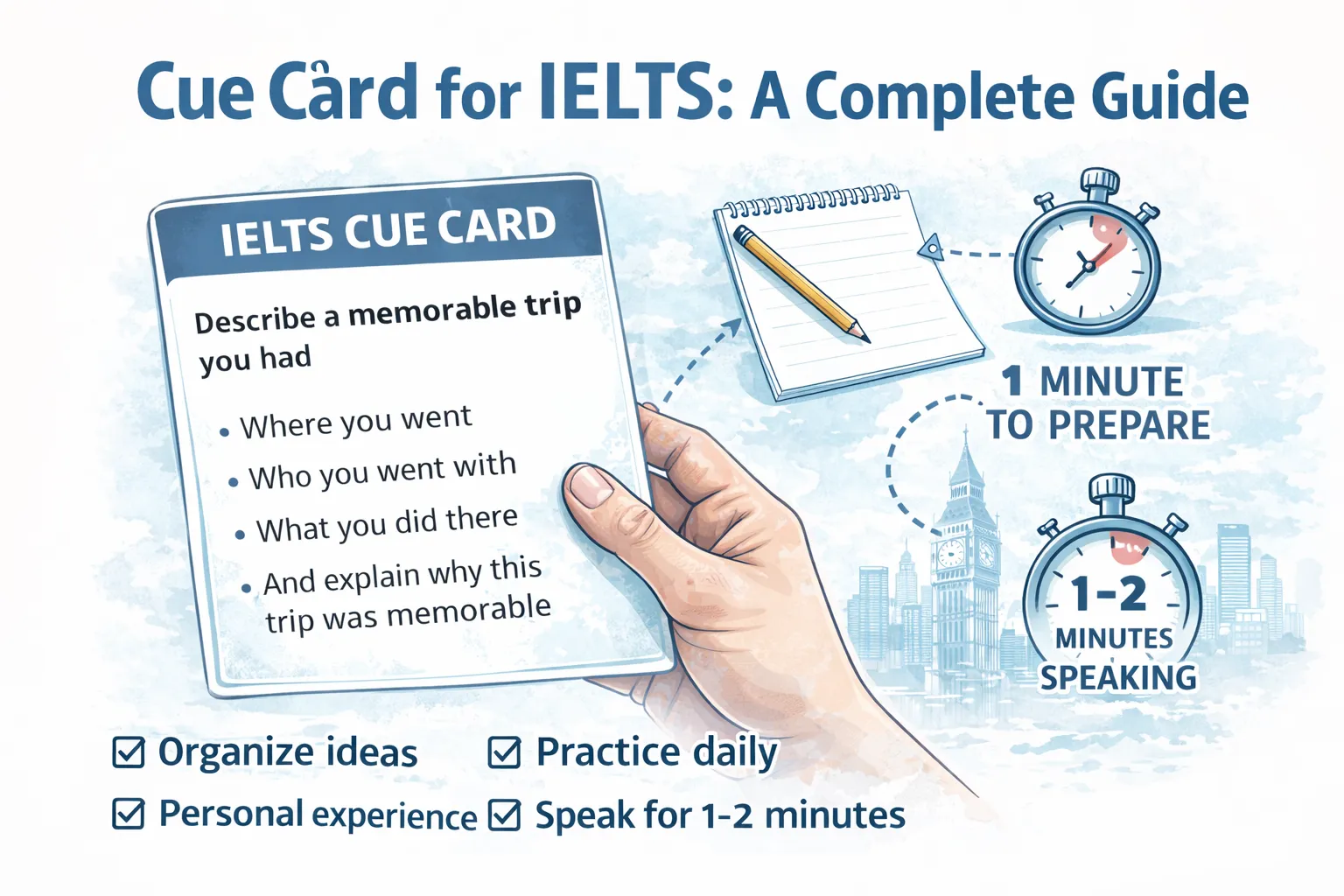
A cue card is part of the Speaking Part 2 of the IELTS test. In this section, the examiner gives you a small card with a topic written on it. The card also contains 3–4 points that help you explain your answer.
You must talk about the topic for 1 to 2 minutes.
Before speaking, you get one minute to prepare your ideas.
During this time, the examiner also gives you a pencil and paper so you can write short notes.
Structure of the IELTS Cue Card
A cue card usually follows a simple structure.
Example Cue Card Topic
Describe a memorable trip you had.
You should say:
- Where you went
- Who you went with
- What you did there
- And explain why this trip was memorable
This structure helps students organize their answers easily.
Time Format of the Cue Card
The cue card section follows a clear timeline.
1 minute — preparation time
1–2 minutes — speaking time
1–2 follow-up questions — examiner discussion
The examiner may stop you if you speak longer than two minutes.
Why Cue Cards Are Important
The cue card plays a big role in your speaking band score.
The examiner checks several things during your speech:
- Fluency and confidence
- Vocabulary usage
- Grammar accuracy
- Pronunciation
A strong answer can improve your overall speaking band score.
Simple Strategy to Answer a Cue Card
Many students make the mistake of speaking without structure. A better method is to follow a simple speaking pattern.
1. Start with a short introduction
Begin by introducing the topic.
Example:
“Today I would like to talk about a trip that I will never forget.”
2. Explain the background
Give basic details such as place, time, and people.
Example:
“I visited the northern areas of Pakistan with my friends during our summer vacation.”
3. Describe the experience
This part should contain the most information. Talk about activities, feelings, and details.
Example:
“We explored mountains, took many photographs, and enjoyed the peaceful environment.”
4. End with a conclusion
Finish your answer by explaining why the topic is important.
Example:
“That trip was very special because it allowed me to relax and spend quality time with my friends.”
Example IELTS Cue Card Answer
Cue Card Topic
Describe a teacher who influenced you.
Sample Answer
One teacher who influenced me a lot is my English teacher from high school. Her name is Mrs. Sarah. She taught us English for almost two years.
She always encouraged students to speak English in class. At first, many students felt shy, including me. However, she created a friendly environment where everyone could practice without fear.
She also introduced interesting activities such as debates, storytelling, and group discussions. These activities helped us improve our confidence and communication skills.
I still remember her advice: “Practice every day, and never be afraid of making mistakes.” Because of her guidance, I became more confident in speaking English.
That is why I believe she had a strong influence on my learning journey.
Common Cue Card Topics in IELTS
Students usually receive topics from everyday life. Some common topics include:
- Describe your favorite book
- Describe a person who inspires you
- Describe a place you like to visit
- Describe a memorable event
- Describe a skill you want to learn
Practicing these topics helps students feel more confident in the exam.
Tips to Get a High Score in Cue Card
Practice Speaking Daily
Speaking English every day improves fluency and confidence.
Use Simple Vocabulary
You do not need very difficult words. Clear and natural vocabulary works best.
Organize Your Ideas
Use the points on the cue card to structure your answer.
Avoid Long Pauses
Small pauses are fine, but try to keep speaking naturally.
Add Personal Experience
Examiners like answers that include real experiences and emotions.
Common Mistakes Students Make
Many students lose marks because of simple mistakes.
Some common problems include:
- Speaking for less than one minute
- Repeating the same idea again and again
- Using very basic vocabulary
- Pausing too much while thinking
Regular practice can help you avoid these issues.
Practice Method for Cue Cards
Students can improve their cue card performance by following this method:
- Pick a random topic.
- Prepare for one minute.
- Speak for two minutes without stopping.
- Record your voice and review your answer.
This method helps you improve fluency, vocabulary, and confidence.
Final Thoughts
The cue card section of the **IELTS speaking test may look difficult, but with practice, it becomes much easier. The key is to stay calm, organize your ideas, and speak clearly.
Remember, the examiner does not expect perfect English. They want to see your ability to communicate ideas confidently.
With regular practice and the right strategy, you can achieve a strong score in the IELTS speaking test.