
If you want to study or work abroad, you will likely need to take an English language test. Two of the most popular tests are PTE Academic and IELTS. Many students often ask one simple question: How do PTE and IELTS scores compare?
In this guide, we will explain the PTE vs IELTS score system in simple words so even a 10th-grade student can easily understand it.
What Is IELTS?
International English Language Testing System, commonly called IELTS, is one of the most trusted English tests in the world. Universities, immigration offices, and employers accept it in countries like the UK, Australia, Canada, and New Zealand.
The IELTS test checks four important English skills:
- Reading
- Writing
- Listening
- Speaking
Each section receives a score between 0 and 9, and the final result is the average band score.
Example:
If a student scores 6 in reading, 7 in listening, 6 in writing, and 6 in speaking, the final IELTS score will be around 6.25, which rounds to 6.5.
What Is PTE?
Pearson Test of English Academic, also called PTE Academic, is a computer-based English test. Many universities and immigration departments now accept it.
The test also measures four main skills:
- Speaking
- Writing
- Reading
- Listening
However, the scoring system is different. PTE uses a scale from 10 to 90.
The test is fully computer-based, and a computer checks most answers.
PTE vs IELTS Score Comparison
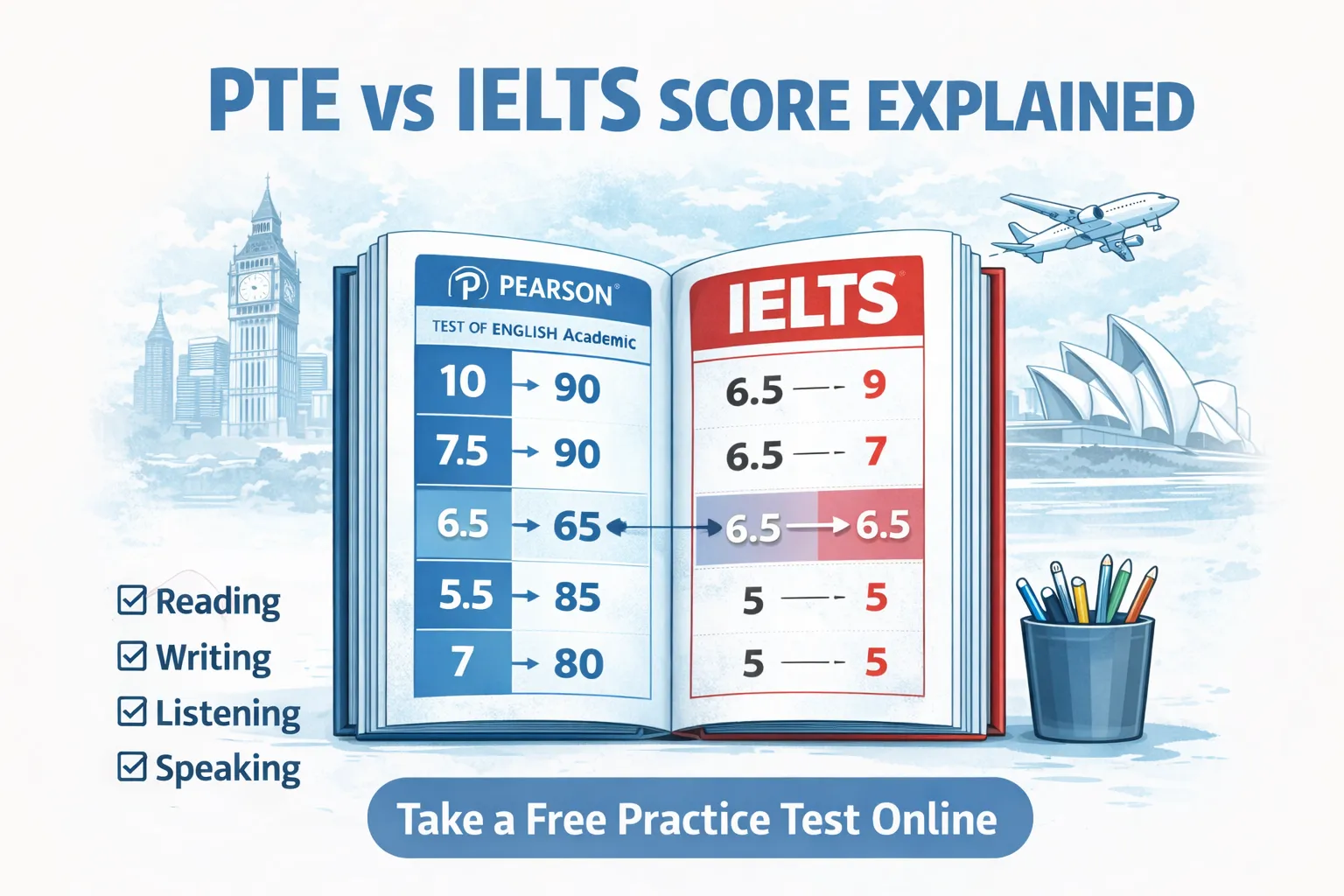
Students often struggle to understand how PTE scores match IELTS bands. The table below shows a simple comparison.
| IELTS Band | PTE Score |
|---|---|
| 9 | 86 – 90 |
| 8.5 | 83 – 85 |
| 8 | 79 – 82 |
| 7.5 | 73 – 78 |
| 7 | 65 – 72 |
| 6.5 | 58 – 64 |
| 6 | 50 – 57 |
| 5.5 | 42 – 49 |
| 5 | 36 – 41 |
For example:
- IELTS 7 = around PTE 65
- IELTS 6.5 = around PTE 58
- IELTS 6 = around PTE 50
Most universities ask for IELTS 6 or 6.5, which means students need PTE 50–58.
Key Differences Between PTE and IELTS Scores
1. Score Scale
The biggest difference is the scoring scale.
- IELTS score range: 0 – 9
- PTE score range: 10 – 90
Because of this difference, students often find PTE scores easier to understand when comparing performance.
2. Scoring Method
IELTS uses human examiners for the speaking and writing sections.
PTE uses AI and computer scoring for most tasks.
This makes the PTE test more consistent, while IELTS allows human judgment.
3. Result Time
PTE usually provides results faster.
- IELTS results: 3–13 days
- PTE results: 1–2 days
Students who need quick results often prefer PTE.
4. Speaking Test
The speaking test also works differently.
In IELTS, you speak directly with an examiner.
In PTE, you speak into a microphone and computer.
Some students feel more comfortable speaking to a computer.
Which Score Is Easier to Get?
This depends on the student.
Some students prefer IELTS because they can talk to a real person during the speaking test.
Others prefer PTE Academic because:
- The test is fully computer-based
- Results come faster
- The scoring system feels more flexible
Students who type fast and feel comfortable with computers often perform well in PTE.
Which Test Do Universities Accept?
Today, most universities accept both tests.
Countries that widely accept IELTS and PTE include:
- Australia
- Canada
- United Kingdom
- New Zealand
However, students should always check the university admission requirements before choosing a test.
Simple Example of Score Conversion
Let’s say a university requires:
- IELTS 6.5
You can also apply with:
- PTE score around 58–64
Both scores show a similar level of English ability.
Final Thoughts
Both PTE Academic and IELTS test the same English skills: reading, writing, listening, and speaking. The main difference lies in the scoring system and test format.
If you prefer speaking with a person, IELTS may suit you better.
If you like computer-based tests and quick results, PTE could be the right choice.
Before you decide, check the score requirement of your university and choose the test that matches your strengths.